

Why Your Child Falls Apart After School—and What to Do About It
“His teacher says he had a GREAT day.”
Then he gets in the car…he’s rude to his sibling.
He doesn’t want to answer a single question.
He melts down because you brought the wrong snack.
He cries over homework.
Or he walks through the front door and suddenly has enough energy to climb the walls.
And you’re thinking: How did we go from “great day at school” to THIS in ten minutes?
This is one of the most common things I hear from parents at the beginning of the school year.
And as a child therapist, one of the first things I want parents to understand is: A child can have a genuinely good day at school AND come home completely dysregulated.
Those two things can exist at the same time.
Think About Everything Your Child’s Brain Has Done Today
School requires a tremendous amount of regulation. For hours, your child may have been expected to:
Sit when they’re supposed to sit.
Move when they’re supposed to move.
Listen.
Learn.
Remember directions.
Wait their turn.
Navigate friendships.
Ignore distractions.
Handle disappointment.
Manage frustration.
Transition from one activity to another.
Deal with noise.
Follow rules.
Keep track of their belongings.
Solve problems.
Ask for help.
And regulate their emotions while doing all of it.
Even recess—the “break”—can require social problem-solving, flexibility, negotiation, and self-control.
Then the final bell rings. Your child sees you. And suddenly…They’re done.
Why Kids Often Fall Apart With Their Parents
This part can feel really personal. Parents will tell me: “Why can he hold it together for his teacher but not for me?” Or: “She would NEVER talk to her teacher the way she talks to me.”
It can feel like your child is giving everyone else their best behavior and saving the worst for you. But there’s another way to look at it. Home is often where kids finally stop working so hard to hold everything together.
Think about how you feel after a long day. You might be patient at work. Professional during meetings. Friendly with coworkers. Then you walk through your own front door, take off your shoes, and think: “I don’t want anyone to ask me for anything.” Kids experience their own version of this. Their capacity is depleted and sometimes the smallest demand is the thing that tips them over.
What After-School Dysregulation Can Look Like
It doesn’t always look like crying. Your child might:
Melt down over something tiny.
Argue about everything.
Become extremely silly or wild.
Pick fights with siblings.
Demand screens.
Refuse homework.
Become clingy.
Want to be alone.
Complain about everything.
Say they hate school even though their teacher says they had a great day.
Shut down and refuse to talk.
Seem exhausted.
Become unusually sensitive.
Have absolutely no tolerance for hearing “no.”
Different nervous systems release stress differently.
The important question isn’t: “Why are they behaving like this?”
Try: “What does their body need after everything it just did?”
Stop Making the First 20 Minutes Another Performance
This is one of the biggest changes I’d encourage parents to make. Your child gets in the car and immediately hears:
“How was your day?”
“What did you learn?”
“Did you turn in your homework?”
“Who did you play with?”
“Did you eat your lunch?”
“We have soccer at 4:30, so when we get home you need to change and do your homework.”
That’s a lot. Your child has just spent hours responding to demands. Give their nervous system a transition. You don’t need to completely reorganize your afternoon. Even 15–20 minutes can help.
Create an After-School Reset
Instead of immediately moving from school mode → home responsibilities, build something in between.
I call this an: AFTER-SCHOOL RESET
Your child’s reset might include:
Snack + water
Movement
Quiet
Connection
Sensory input
Outside time
Different kids need different things. The goal isn’t to find the perfect after-school routine.
It’s to figure out: What helps MY child’s body transition out of school mode?
1. Feed Them Before You Question Them
This is one of the simplest strategies—and one of my favorites.
Have food ready. School lunch may have been hours ago. They may not have eaten much of it and regulating emotions is a lot harder when you’re hungry and tired.
Instead of starting with: “Tell me about your day!”
try: “I’m happy to see you. I brought you a snack.”
Then let them eat. You can talk later.
2. Figure Out Whether Your Child Needs Movement or Quiet
This is where knowing your child matters. Some kids need to move after school. They might benefit from:
Running outside.
Jumping on a trampoline.
Riding a bike.
Shooting baskets.
Walking the dog.
Dancing.
Going to the playground.
Other kids need the exact opposite.
They need:
A quiet room.
A book.
Drawing.
Music.
A blanket.
Time alone.
Very little conversation.
And some kids need both: Movement first. Quiet second. There isn’t one correct reset. Experiment until you find what helps your child’s body settle.
3. Connection Doesn’t Have to Mean Conversation
Parents often think connecting after school means getting their child to tell them about their day. It doesn’t.
Connection might look like:
Sitting next to them while they eat.
Giving them a hug.
Driving quietly together.
Listening to their favorite song.
Playing outside.
Letting them tell you something completely unrelated to school.
You can communicate: “I’m happy you’re home.” without requiring: “Tell me everything that happened.”
4. Delay Your Questions
If your child answers every after-school question with:
“Fine.”
“I don’t know.”
“Nothing.”
They may simply not be ready to talk. Try waiting. Ask during dinner, at bedtime, while driving to practice, while coloring together. Children often talk more when their nervous system has had time to settle.
When you do ask, skip the enormous question:
“How was your day?”
Try something specific:
“What made you laugh today?”
“Who did you sit with at lunch?”
“What was the hardest part of your day?”
“Did anything surprise you?”
One specific question is enough. Want better questions to ask when they are ready to talk? One of my favorite blogs includes 20 questions to ask instead of “How was your day?” These specific conversation starters make it easier for kids to share the funny, hard, interesting, and meaningful parts of their day.
5. Reduce Demands Before Adding More Demands
Your child eventually needs to:
Do homework.
Empty their backpack.
Go to practice.
Help with chores.
Get ready for dinner.
I’m not suggesting we eliminate expectations. I’m suggesting we think about timing. A child who is completely dysregulated may not have the capacity to immediately transition into another set of demands.
Try: School → Reset → Responsibilities
instead of: School → Responsibilities → Meltdown → Everyone Is Frustrated
Sometimes twenty minutes of intentional decompression saves you an hour of conflict later.
6. Make the Reset Predictable
Kids do well when they know what’s coming. Instead of negotiating every afternoon, create a simple rhythm.
For example:
HOME
↓
SNACK + WATER
↓
20-MINUTE RESET
↓
BACKPACK/HOMEWORK
↓
PLAY
Your routine doesn’t have to look like anyone else’s. What matters is that your child begins to know “When I get home, I get a chance to reset before the next thing.” Predictability itself can be regulating.
7. Don’t Remove the Boundary—Change How You Hold It
Understanding your child’s nervous system doesn’t mean: “They’re dysregulated, so anything goes.”
Your child can be overwhelmed and still need boundaries.
If they scream at a sibling: “You’re really done after a long day. I won’t let you yell at your brother like that. Let’s get some space.”
If they throw something: “You’re really frustrated. I’m not going to let you throw that. Let’s help your body reset.”
Both can be true: “I understand why this is hard.” AND “I’m still going to hold the boundary.”
Regulation isn’t permissiveness. It’s helping a child get back to a place where they can access the skills we’re asking them to use.
Parenting Scripts
When They Get in the Car Completely Done
Instead of: “How was your day? What did you do? Who did you play with?”
Try: “I’m happy to see you. You don’t have to tell me about your day yet.”
When They Melt Down Over Something Tiny
Instead of: “You’re seriously crying about THAT?”
Try: “That was the thing that tipped you over. Your body looks really done.”
When They’re Snapping at Everyone
Instead of: “Why are you so grumpy?”
Try: “It looks like you need some space to reset before we do anything else.”
When They Refuse Homework
Instead of immediately escalating: “You have to do it right now.”
Try: “Your brain has worked hard all day. Let’s reset first, then we’ll make a plan for homework.”
When They Hurt a Sibling
Try: “You can be overwhelmed. You cannot hurt your brother. I’m going to help you get some space.”
When They Don’t Want to Talk
Try: “You don’t have to talk right now. I’m here when you’re ready.”
Therapist Tip: Don’t Judge the School Day by the After-School Meltdown
This is important. A child falling apart after school doesn’t automatically mean school is going badly.
And a teacher saying: “They were wonderful all day!” doesn’t mean you’re imagining what happens at home. Both experiences can be true. Your child may genuinely enjoy school. They may also be working incredibly hard to meet the demands of it.
Instead of asking: “Which version of my child is the real one?”
recognize that you’re seeing your child in two very different environments with two very different levels of demand and capacity.
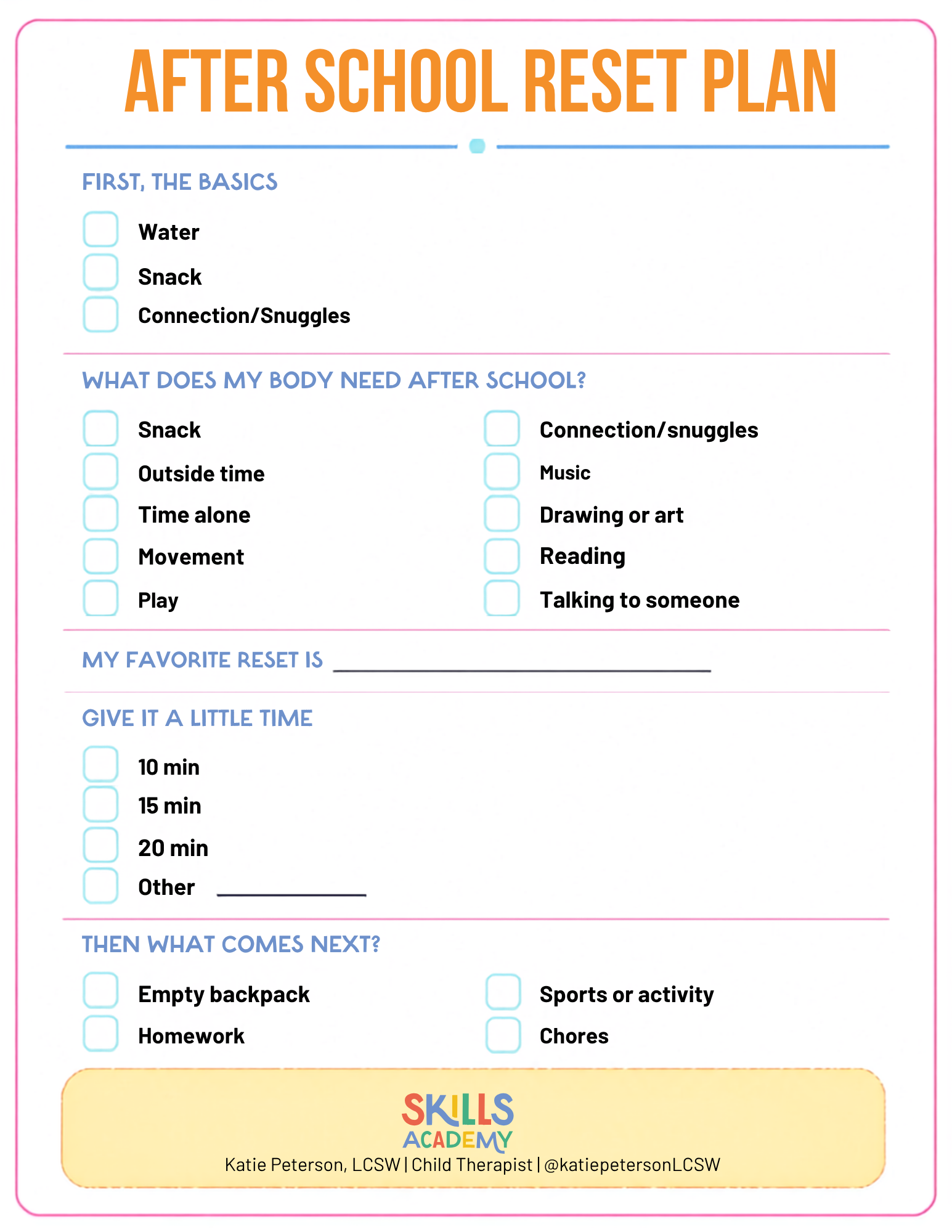
Create Your Child’s After-School Reset Plan
This can be a great conversation to have when your child is calm, not during the meltdown.
Ask: “When you get home from school, what helps your body feel better?”
Then create a short menu together.
MY AFTER-SCHOOL RESET
Try This Tomorrow
When your child gets home from school, experiment with doing less for the first 20 minutes.
Don’t ask five questions. Don’t immediately start homework. Don’t interpret every grumpy response as disrespect.
Try:
Food.
Water.
Less talking.
Movement or quiet.
Connection without demands.
Then notice: What changes?
You may discover your child doesn’t need a complicated behavior plan after school. They need a better transition.
Remember
When your child falls apart after school, try not to immediately think: “They’ve behaved all day. Why can’t they do it for me?”
Instead, get curious: “What has their nervous system been managing all day—and what does it need now?”
Your child may need food.
Movement.
Quiet.
Connection.
Fewer questions.
A little time without another expectation. Then you can move into homework, chores, activities, and the rest of your evening. We’re not removing expectations. We’re creating a bridge between school and home. Sometimes that small pause is exactly what a tired, emotional, overloaded child needs to get back to themselves.
My Favorite Family Finds
TINCAN Phones for Kids
A screen-free way for kids to stay connected while building communication skills and independence. Communication without screens!
Camp Snap Screen-Free Camera: Use code: KATIE-P7 for 7% off your order!
A fun, screen-free camera kids can use to capture their own adventures, vacations, school-year moments, and everyday memories—without handing them a phone.
Time Timer
One of my favorite visual tools for helping kids see how much time is left. Great for morning routines, homework, getting out the door, screen-time transitions, clean-up, and more.
My Back-to-School Favorites
All the things I love for making the school year run a little smoother—from lunch and organization favorites to routine helpers, kid essentials, and tools we actually use at home.
ShopMy Favorites
Shop all my favorite mom finds, parenting tools, home favorites, kids’ essentials, and everyday products I love and recommend.
My Amazon Storefront
Browse my favorite parenting tools, organization finds, sensory products, kids’ essentials, travel favorites, and everyday family must-haves.
Affiliate Disclaimer: This post may contain affiliate links. If you purchase through these links, I may earn a small commission at no extra cost to you. Thank you for supporting my work and helping me continue creating resources for kids and families.
