

Sibling Rivalry Scripts: What to SayWhen Your Kids Won't Stop Fighting
If you've searched anything like "how to stop my kids from fighting" at 6pm with a wooden spoon in one hand, you already know the theory isn't the problem. You know siblings fight. What you don't have, in the actual moment, is the right sentence. I'm Katie Peterson, a licensed clinical social worker and child therapist who's spent the last ten-plus years helping families with exactly this. Below are four real scripts — the same ones I use with families in my practice — for the sibling fights that happen almost every day in a house with more than one kid.
Why Siblings Fight So Much (and Why That's Actually Normal)
Sibling conflict is one of the most common — and most normal — parts of raising more than one child. It isn't a sign that something is wrong with your kids, or with your parenting. Siblings fight more than friends do because they can: there's non social cost to losing your temper with a brother who'll still be there tomorrow. Underneath almost every sibling fight is a behavior you can see and a need you usually can't. Grabbing a toy is often really about wanting connection. Repeated tattling is often about feeling powerless. Learning to notice the need instead of only reacting to the behavior is most of the skill.
The Problem With "Just Share" and "Stop It"
Both of those phrases ask a child to stop a behavior without giving them anything to do instead. They also put you in the position of referee, deciding who's right — which teaches your kids that you'll solve it for them, rather than that they can solve it themselves. The scripts below do something different: they hand the problem back, in words your kids can actually use.
4 Sibling Rivalry Scripts You Can Use Today
1. The toy or turn dispute.
Both kids want the same toy or turn, right now, and it's about to become a tug-of-war.
Instead of: "Just share!" or "Whoever had it first gets it."
Try this: "You both want this right now — that's a hard problem. What's one idea to make this fair?"
Why it works: handing them the problem to solve together teaches sharing. Handing down a verdict just teaches who won today.
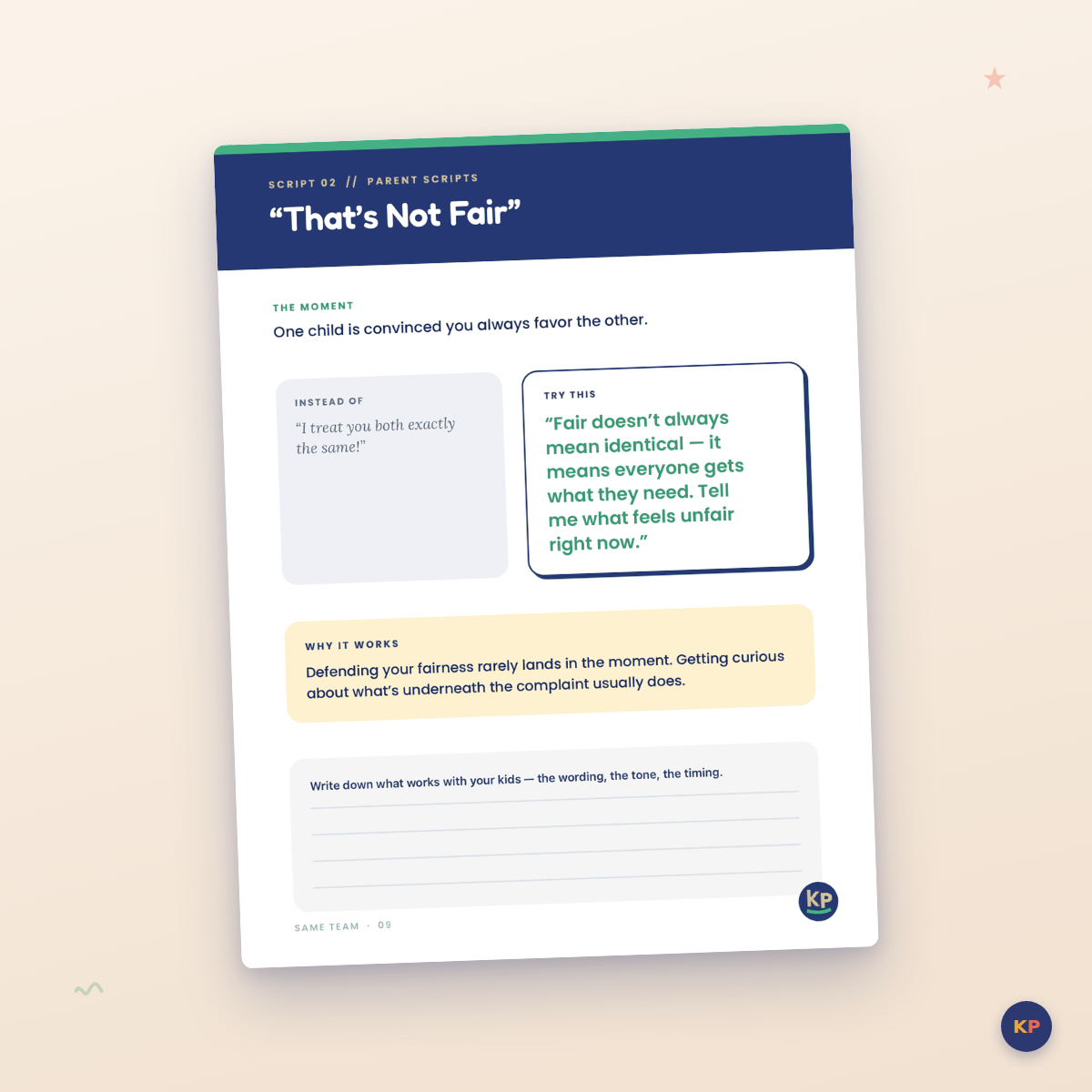
2."That's not fair."
One child is convinced you always favor the other.
Instead of: "I treat you both exactly the same!"
Try this: "Fair doesn't always mean identical — it means everyone gets what they need. Tell me what feels unfair right now."
Why it works: defending your fairness rarely lands in the moment. Getting curious about what's underneath the complaint usually does.
3. Tattling.
"He's not doing it right!" "She's not sharing!" — the tenth report this hour.
Instead of: "Stop tattling."
Try this: "Are you telling me because someone's in danger, or because you want help fixing something you could try first?"
Why it works: this one question sorts real safety reports from bids for control, and hands small problems back to the kid who can likely solve them.
4. Hitting or pushing.
It went physical.
Instead of: "Say sorry right now."
Try this: "Bodies apart first. Hands are not for hurting, even when you're really mad.
Then circle back to repair once everyone's calm.
Why it works: safety comes before the lesson. Separating bodies — not shaming — calms the nervous system so repair can actually work later.
What to Do When a Fight Turns Into a Meltdown
Sometimes a sibling fight doesn't stop at a script — it tips into a full meltdown for one or both kids. When that happens, the goal shifts from solving the problem to calming the body: separate bodies into different spaces, lower your own voice before asking for theirs, and save any problem-solving for once everyone is actually calm. You cannot resolve a fight with a dysregulated nervous system, yours or theirs.
When You Need More Than a Blog Post
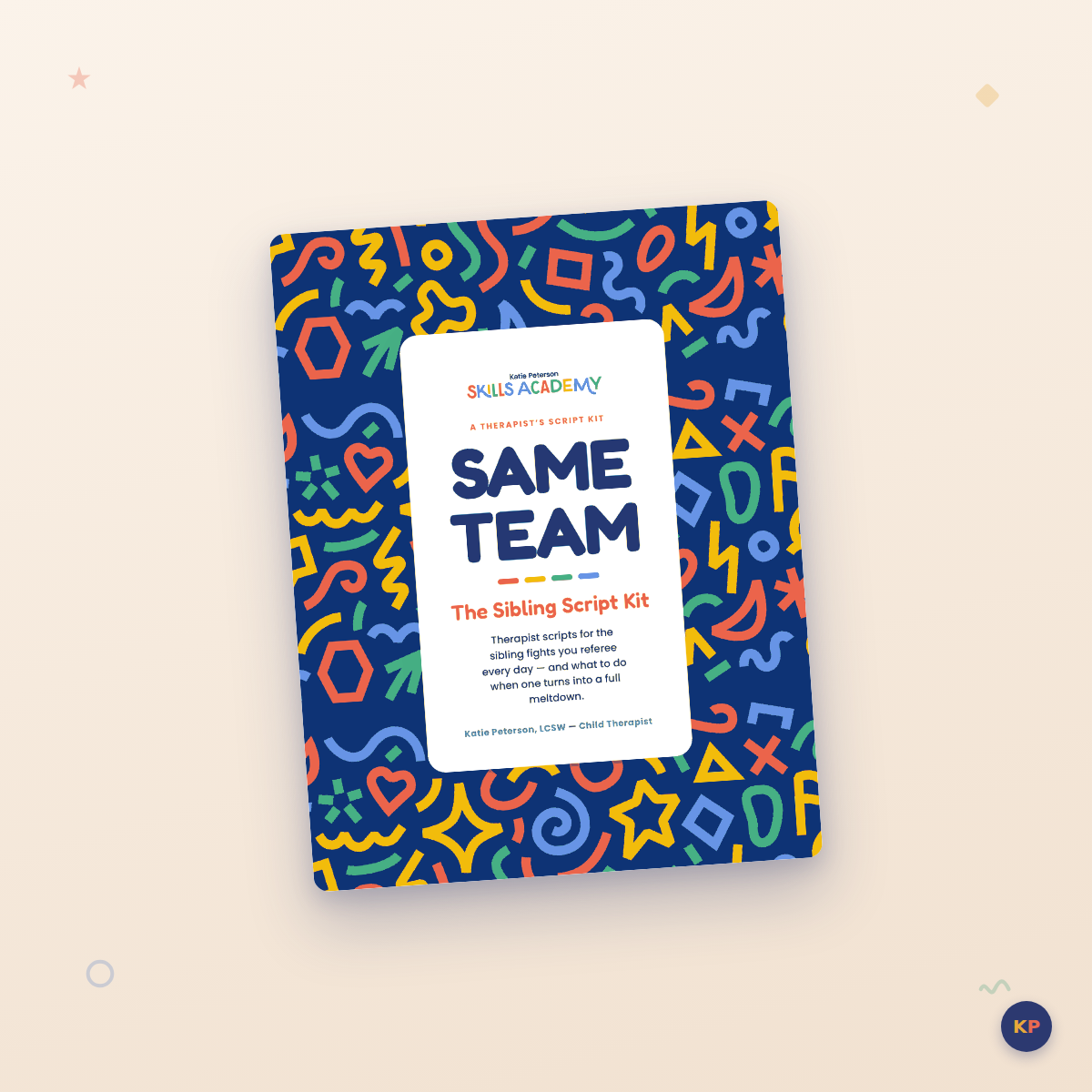
These four scripts cover a lot of ground, but they're four of twelve. If you want the rest — plus the meltdown tools, a repair card, a family agreement your kids help write, and pocket cards for the car and kitchen — that's what's inside Same Team: The Sibling Script Kit, for $27.
Stop refereeing. Start teaching the skill.
Same Team is a therapist-built script kit for the sibling fights you're having right now — the toy grab, the tattling, the backseat brawl, the "you always take their side." Instead of a lecture or a generic parenting tip, you get the exact words to say, organized by the fight you're actually in.
Built by Katie Peterson, LCSW, a child therapist with 10+ years of experience, this isn't another feelings-wheel printable. It's 12 scenario-specific sibling rivalry scripts, a 5-minute instant-win card, a six-step process for teaching kids to solve conflict themselves, early-warning signs for when a fight is about to tip into a meltdown, and cut-out pocket cards for the car, the kitchen, or your wallet.
What's inside:
12 full scripts (Instead Of / Try This / Why It Works)
The Right-Now Card
The Six-Step Solve-It-Together framework
2 Make-It-Better repair cards
The Same Team family agreement
4 pocket cards
28 print-ready pages
*Instant PDF download. Use it tonight, for the fight already happening in your house.
My Favorite Family Finds
TINCAN Phones for Kids
A screen-free way for kids to stay connected while building communication skills and independence. Communication without screens!
Camp Snap Screen-Free Camera: Use code: KATIE-P7 for 7% off your order!
A fun, screen-free camera kids can use to capture their own adventures, vacations, school-year moments, and everyday memories—without handing them a phone.
Time Timer
One of my favorite visual tools for helping kids see how much time is left. Great for morning routines, homework, getting out the door, screen-time transitions, clean-up, and more.
My Back-to-School Favorites
All the things I love for making the school year run a little smoother—from lunch and organization favorites to routine helpers, kid essentials, and tools we actually use at home.
ShopMy Favorites
Shop all my favorite mom finds, parenting tools, home favorites, kids’ essentials, and everyday products I love and recommend.
My Amazon Storefront
Browse my favorite parenting tools, organization finds, sensory products, kids’ essentials, travel favorites, and everyday family must-haves.
Affiliate Disclaimer: This post may contain affiliate links. If you purchase through these links, I may earn a small commission at no extra cost to you. Thank you for supporting my work and helping me continue creating resources for kids and families.
